 English
 Bahasa Melayu
 中文
中文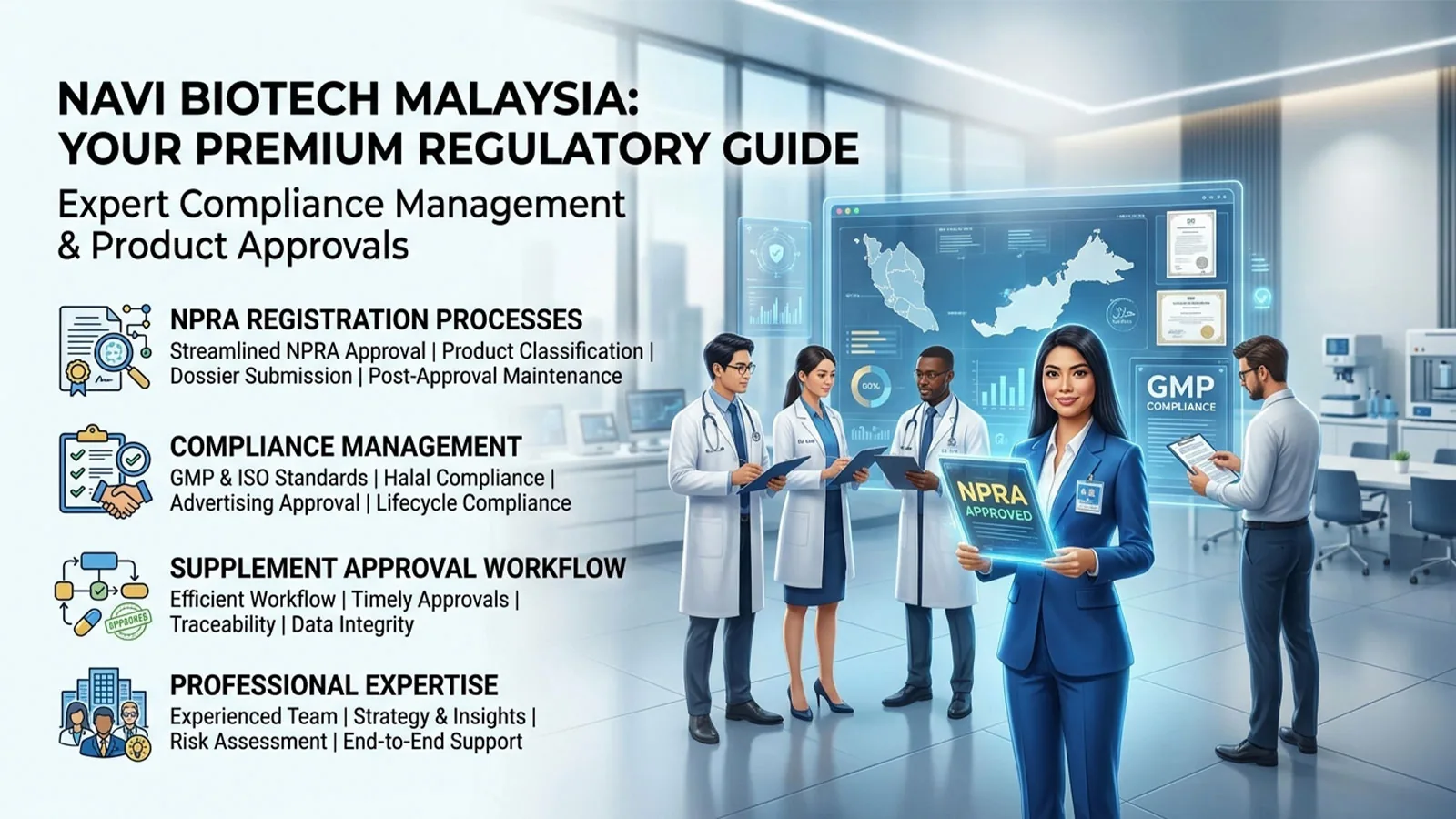
NPRA registration
& the MAL number.
How supplement registration works in Malaysia — what the NPRA is, what a MAL number is, the process, and what your manufacturer handles for you.
You cannot legally sell a supplement in Malaysia until it is registered. The process is manageable, especially when your manufacturer handles it — but it pays to understand it. Here is the essentials.
What the NPRA is
The NPRA — the National Pharmaceutical Regulatory Agency, under the Ministry of Health — is the body that assesses pharmaceuticals, health supplements and cosmetics before they reach the Malaysian market. The registration decision itself sits with the Drug Control Authority (DCA), the executive body established under the Control of Drugs and Cosmetics Regulations 1984; the NPRA carries out the evaluation and runs the submission system behind it.
Four functions sit under that mandate: registering products, licensing importer, manufacturer and wholesaler premises, monitoring the quality of registered products already on the market, and monitoring adverse reactions. A supplement is therefore handled as a regulated product rather than a grocery item — the formula, the claims, the label and the factory that makes it are all in scope.
That scope continues after approval, because the authority can suspend or cancel a registration. Compliance is a standing obligation, not a one-time hurdle you clear before launch.
What a MAL number is
A MAL number is the registration number the authority assigns to your product once it is registered, and it has to appear on the pack. It is what makes the supplement legal to sell in Malaysia, and it is the first thing a distributor, pharmacy buyer or marketplace will ask you for.
It is not permanent. Registration is valid for five years, or such period as the authority's database specifies, and it can be suspended or cancelled in that time. Throughout the period the registration holder is responsible for keeping the product's quality, safety and efficacy to the conditions approved, and must re-register before the five years run out.
Because the number is tied to one formula, one holder and one manufacturer, it doubles as a verification tool: anyone can look it up in the NPRA product search and check that the pack in front of them matches what was actually registered.
Source: NPRA: Step 3 — Regulatory Outcome for Health Supplements
The registration process
Four steps: screen the formula, build the dossier, submit it through the NPRA's online system, then answer queries until the MAL number is issued. Screening comes first because the guideline is specific — health supplements must be oral dose forms, with no injectable or sterile preparations, and 26 vitamins and minerals carry upper daily limits for adults, vitamin C capped at 1,000 mg and vitamin D at 1,000 IU a day.
The dossier then has to hold together: product particulars, the batch manufacturing formula, packaging, label artwork, manufacturer and GMP documentation, finished-product quality control and stability data. Claims are constrained too — the permitted indication for a health supplement is use as a health supplement, so copy that drifts towards treating a condition will not clear evaluation.
Most delay is self-inflicted, caused by an ingredient over its limit or a missing certificate rather than by the regulator's queue.
What we handle for you
We run the whole submission: screening the formula against permitted ingredients and daily limits, assembling the dossier, filing it through the NPRA's QUEST system, answering queries, and staying with it until the MAL number is issued — then the export certificates if you are selling abroad.
The pre-submission list is as much administrative as scientific. It takes a GMP certificate for the manufacturing site, company membership and a digital certificate on a USB token for QUEST access, and, for anything imported, a Certificate of Pharmaceutical Product or Certificate of Free Sale from the competent authority in the country of origin.
Because we hold the GMP site and file in-house, registration runs alongside production instead of after it — roughly three months from brief to first stock for a straightforward formula, with samples in two to three weeks while the dossier is still being built.
Source: NPRA: Step 1 — Pre-submission of Application (Preparation) for Health Supplements
Frequently asked questions on this topic
Quick answers.
Do I need a MAL number to sell a supplement in Malaysia?
Yes — a supplement must be notified to the NPRA and carry its MAL number to be sold legally. We handle the registration that obtains it.
How long does NPRA registration take?
It varies with the product and the regulator's workload. A complete, compliant dossier prepared up front is the best way to avoid avoidable delays.
Can you handle the registration for me?
Yes — we prepare and submit the dossier and manage the process through to your MAL number, so you do not navigate the NPRA yourself.
What about selling overseas?
For export we also secure the Certificate of Free Sale and can register with the destination market's authority, so the product is legal abroad too.
More guides
Need your product registered?
Tell us the product and your markets — we will handle NPRA registration and your MAL number.