 English
 Bahasa Melayu
 中文
中文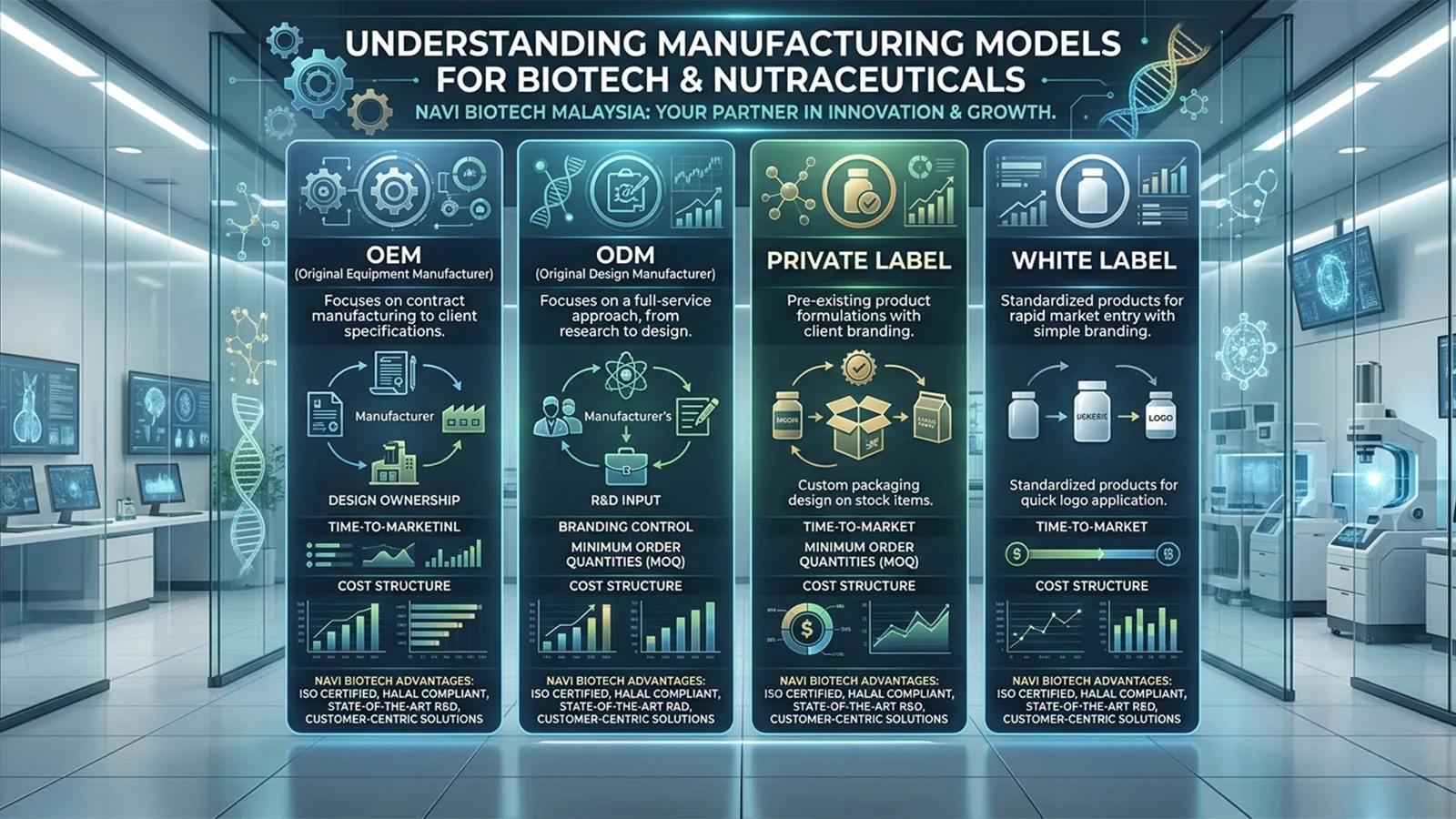
OEM vs ODM vs
private label.
The manufacturing models explained in plain English — OEM, ODM, private label, white label and toll — and how to pick the right one.
These terms get used interchangeably, but they describe genuinely different ways of working — and choosing the wrong one costs time or control. Here is what each actually means.
Private label / white label
Private label means putting your brand on a formula the manufacturer already owns and has already proved. It is the fastest and lowest-cost route to market because the product exists: no development cycle, no stability programme from scratch. White label describes the same arrangement — the two terms are used interchangeably in Malaysia — and in both cases the formula is a shared base rather than something built for you.
What does change is the paperwork. The finished product still has to be registered with NPRA before you can sell it, the registration certificate has to be held by a company registered in Malaysia, and the eight-digit MAL number NPRA issues must be printed on your label or packaging. So although the formula is borrowed, the compliance record carries your brand's name.
Use private label to test a positioning, a price point or a channel with one SKU, then reinvest what you learn.
Source: NPRA — FAQ: Product Registration
OEM
OEM means you bring the concept and the specification, and the manufacturer formulates and produces to it. Your product, their production line. You decide the actives, the doses and the positioning; they translate that brief into something that can actually be made, held stable in a tropical climate and registered. Expect more control and more originality than private label, with a development period to match.
NPRA treats a health supplement as a product supplied in small unit dosage forms — capsules, tablets, powders and liquids — and routes every one of them through the same four-step registration process. Vitamins, minerals, amino acids, fatty acids, enzymes, probiotics and other bioactive substances are all in scope; sterile preparations such as injectables are not. An OEM brief therefore has to be written in terms NPRA can assess, not just terms a marketer likes.
That is the real work in OEM, and it is why a specification written with the manufacturer beats one handed over the fence.
Source: NPRA — Health Supplement: definition and registration process
ODM
ODM means the manufacturer designs the product — formula, format and packaging — from your brief and target market, then makes it. It is the most hands-off route to something original, because the design work sits with the people who know what can be produced and registered. You supply the market insight and the brand; they supply the product decisions.
Those decisions matter more than founders expect, because they set which regulator you answer to. NPRA's product classification guideline puts anything containing one of 61 negative-list ingredients on the drug side, along with pharmaceutical dosage forms such as capsules, soft gels and tablets meant to be swallowed. Gummies, candies and beverages without a dosing instruction are handled as food instead. A single format change moves your product between two different approval routes.
Brief the ODM partner on the market and let them place the product on the right side of that line.
Source: NPRA — Product Classification Guideline: Drugs or Food Products
Toll / contract manufacturing
Toll or contract manufacturing means you already own the formula — and sometimes the raw materials — and you are buying compliant capacity with full QA rather than development. It is the right model when the recipe is settled and the constraint is a licensed plant that can make it at the quality and volume you need.
Capacity of that kind is licensed, not merely rented. Under the Control of Drugs and Cosmetics Regulations 1984 a plant making registered products must hold a Manufacturer's Licence, which carries a RM1,000 processing fee, runs only to 31 December of the year it is granted, and obliges the premises to work to GMP principles. Importers and wholesalers need their own licences at RM500 each and must follow Good Distribution Practice.
So ask to see the licence and its expiry date before you ship a formula anywhere.
Source: NPRA — FAQ: Licensing (Control of Drugs and Cosmetics Regulations 1984)
Which should you choose?
Choose by how much of the product you want to own and how fast you need to be selling. Want speed and low risk? Private label. Want an original product without running the design yourself? ODM. Have a precise specification already? OEM. Own the formula and need compliant capacity? Toll. NaViBiotech runs all four, so the model can fit your stage instead of your stage fitting the model.
The sequencing matters more than the label. Once NPRA approves a product the registration stays valid for five years, so a first launch on a proven base formula buys a long runway to prove demand before you commission a custom OEM version. The holder has to keep that product's quality, safety and efficacy consistent for the whole period, which is an argument for settling the formula before you scale it.
Pick the model you can afford to repeat, not the one that sounds most impressive.
Source: NPRA — Step 3: Regulatory Outcome for Health Supplements
Frequently asked questions on this topic
Quick answers.
Which is cheapest and fastest?
Private/white label, because the formula already exists. Custom OEM and ODM cost more and take longer, but give you a product no competitor sells.
Do I own the formula in each model?
With OEM, ODM and a properly structured private label, the finished formula and brand are yours in writing. Always confirm IP ownership before you start.
Can I move from private label to a custom formula later?
Yes — many brands launch on a proven base formula, then commission a custom OEM/ODM version once the product is proven and volumes justify it.
What does NaViBiotech offer?
All four — private/white label, OEM, ODM and toll — so the model fits your stage rather than forcing your stage to fit the model.
More guides
Not sure which model fits?
Tell us your product and how custom you want it — we will recommend the right route and quote it.